
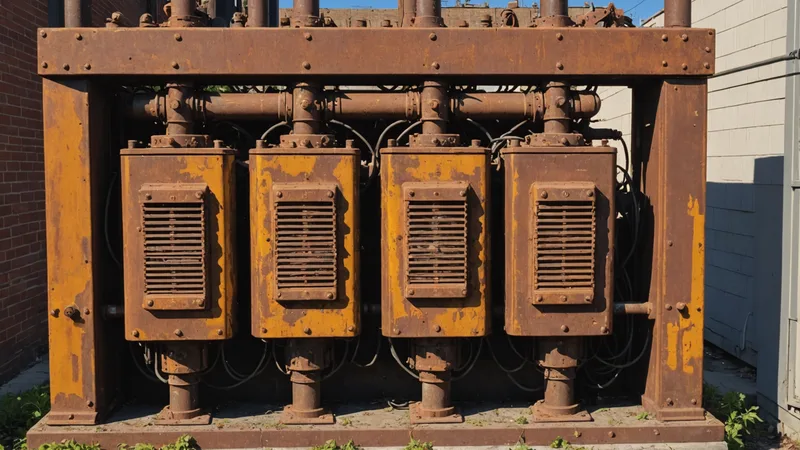

Distribution transformer replacement decisions are among the highest-stakes calls in asset management because they involve significant capital expenditure, multi-week lead times for procurement, and the complexity of planned outage coordination. Getting these decisions right matters both ways: replacing a transformer that has useful life remaining wastes capital; deferring replacement on a transformer with an active developing fault increases the probability of an unplanned event that costs more in every category than the planned replacement would have.
The problem with most asset management programs is not that the criteria are wrong in principle. It is that the information available to apply the criteria is incomplete. This article is about what information you actually need to make the replacement versus monitor decision correctly, and where the gaps typically are.
Age Is a Proxy, Not a Condition Indicator
Many utilities use transformer age as the primary criterion for prioritizing replacement. Replace everything over 35 or 40 years old. This is simple, auditable, and defensible to a regulator or oversight board. It is also a poor predictor of which transformers are actually at elevated near-term failure risk.
The reason is that transformer aging is highly variable across nominally identical units. Two 35-year-old 500 kVA distribution transformers from the same manufacturer, installed in the same year, can have dramatically different remaining insulation life depending on their loading history, the ambient temperature profile of their installation environment, the number and magnitude of through-fault events they have absorbed, and whether they have ever sustained overload conditions. The Montsinger relationship that underlies IEEE C57.91 thermal aging models is well-established: the same chronological age translates to very different paper insulation DP levels depending on operating history.
A transformer that has run lightly loaded in a mild climate for 35 years may have a higher remaining insulation DP than a 20-year-old unit that has been run at 120 percent of nameplate through several heat waves. Age without operating history is a weak input to the replacement decision. Operating history without condition testing is a moderate input. Both together with current condition testing is the decision-quality basis you actually want.
The Information Set You Need
A defensible replace-or-monitor decision requires three categories of information, in roughly increasing order of diagnostic value:
Operating history context. Load history for the past 5 to 10 years, including peak loading, sustained overload events, and cumulative thermal aging index where available. Protection relay event history, specifically the number and magnitude of through-fault events. Ambient temperature profile for the installation location, particularly summer peak conditions. This information is available from SCADA records and protection relay data for most utilities, though it may require some extraction work to consolidate.
Oil and dielectric tests. A recent DGA result, ideally with a trend comparison against a prior result from 1 to 2 years earlier. Power factor and capacitance test on the bushings. Dielectric strength of the insulating oil. Moisture in oil by Karl Fischer titration. These tests characterize the current condition of the oil insulation system and bushing integrity. For a transformer being evaluated for replacement, this is the minimum diagnostic set that should inform the decision.
Winding condition assessment. This is the hardest information to get non-destructively. FRA gives the best non-invasive assessment of winding mechanical condition, but it requires an outage. Where FRA history exists and shows stable transfer functions compared to a factory baseline or a prior measurement, the winding is likely undisturbed. Where FRA shows shifts in transfer function, particularly in the mid-frequency range where internal winding geometry changes are most detectable, that is a meaningful risk flag.
Continuous EM monitoring adds a fourth input for transformers that have been monitored long enough to establish a baseline: the current deviation from that baseline. An EM anomaly on a 35-year-old transformer that is clean on DGA and FRA does not by itself confirm that replacement is necessary, but it raises the risk profile and changes the monitoring cadence. Conversely, a 35-year-old transformer with no EM anomaly, clean recent DGA, and a recent FRA with no significant change from baseline may be a good candidate for continued operation under enhanced monitoring rather than near-term replacement.
When Replacement Is Clearly Right
Some criteria should trigger replacement recommendation without significant ambiguity:
A DGA result showing acetylene above CIGRE Level 2 thresholds, or a DGA pattern consistent with high-energy arcing per the Duval triangle, indicates an active high-energy discharge fault that represents significant near-term failure risk. A bushing power factor exceeding 1.0 to 1.5 percent on a high-voltage bushing, or a 20 to 30 percent increase from a prior measurement, indicates bushing insulation in late-stage degradation. An FRA result showing significant transfer function shift in the series resonance region, consistent with winding displacement, particularly combined with a history of through-fault events.
When multiple indicators are elevated simultaneously, the replacement decision is clearer and more urgent. A 30-year-old transformer with elevated DGA, declining bushing power factor, and a 3-week EM anomaly is a transformer that should go into the replacement queue promptly, not into enhanced monitoring.
When Enhanced Monitoring Is the Better Choice
Not every transformer that crosses an age threshold belongs in the replacement queue immediately. For large distribution fleets, the economics of proactive replacement on age criteria alone are often not favorable when set against what the capital could buy in terms of monitoring coverage, which reduces the unplanned outage rate across the entire fleet.
Enhanced monitoring is the right choice when the current condition data is clean or ambiguous, when the replacement lead time is long enough that a monitored hold with a triggered decision point is safer than waiting without monitoring, or when the transformer is in a position where its criticality does not justify the capital deployment relative to other priorities in the same planning period.
The specific form of enhanced monitoring matters. A transformer in the monitored hold category should have: quarterly DGA samples instead of annual, continuous EM monitoring if not already installed, and a defined trigger set that converts "monitor" to "schedule replacement" automatically. The trigger set should include: any single DGA result showing gas evolution above Level 1 thresholds, any DGA result showing a rate of change that doubles the previous concentration within a 3-month period, or a confirmed EM anomaly that persists for more than 4 weeks. These are not arbitrary thresholds; they represent the points at which the remaining diagnostic uncertainty resolves into a sufficiently confident replacement recommendation.
The Capital Budget Dimension
Replace-or-monitor decisions happen in the context of constrained capital budgets. A utility with 400 distribution transformers, of which 80 are over 30 years old, cannot replace all 80 in a single year. The replacement queue is necessarily prioritized, and the question is whether that prioritization is driven by age rank order, risk rank order, or some combination.
Risk-based prioritization requires the information set described above. Age-based prioritization is cheaper to execute but will include transformers that do not need replacement yet and will exclude younger transformers with developing faults. The monitoring investment enables the risk-based approach: continuous EM monitoring on the at-risk population, combined with targeted DGA acceleration for units showing EM anomalies, produces a dynamic risk ranking of the fleet that is more accurate than a static age-based list.
We are not claiming the monitoring investment is cost-free or that every utility should adopt a risk-based approach immediately. The point is that age-based replacement without condition data is making capital allocation decisions with systematically incomplete information. The monitoring investment does not change the replacement costs; it changes the accuracy of the decision about which transformers get replaced and when. For most fleets, that accuracy improvement has a clear economic return relative to the cost of the monitoring infrastructure.
Data Quality and the Honest Baseline
One practical issue that comes up repeatedly in fleet assessments is that the available condition data is patchier than the records suggest. DGA results are present but the prior comparison result is missing. Bushing power factor measurements are recorded but the baseline test was done under different conditions. FRA data exists for some units but not others, and where it exists it predates a major through-fault event that may have changed the winding geometry.
A sound replace-or-monitor decision requires acknowledging when the data is not sufficient to be confident. A low-data-confidence asset in an elevated-risk age band is a candidate for diagnostic investment, not a candidate for making a capital decision with inadequate information. Sometimes the right answer to the replace-or-monitor question is: we need a DGA sample and an FRA before we can answer this properly. That is a legitimate outcome of the decision process.